
I was invited to create an engaging activity for families.
Invitations like this usually mean I pack my car with tables, a chair, my 10’x10’ canopy, a hand truck, and supplies. It also means I pay to participate. This time was different.
Before the event, arrangements were made for my booth, tables, chairs, and payment.
Yes, payment. This was the first time I was paid for my time and experience as a contributor to a community event.
When I arrived, my booth was ready. I was recognized as a professional contributor.
I admit this was a bit startling. At this moment, I realized how much I’d come to not expect compensation. Work involving nature, children, and families often comes with the unspoken assumption, “Oh, you work for free.”
And that you do the work you do because it is a calling.
Callings don’t involve invoices.
A researcher studying museum educators also documented this sentiment.
“A higher individual at my institution said being an informal educator is ‘a calling’ and as such those called to do it should expect not to be paid very much.” (1)
I wondered what other freelance educators experienced. Did others expect to earn less, too?
Through a survey, I gained insight into the depth of educators' experiences, the topics they teach, and the programs they lead.
I learned that most of the freelance informal science educators who responded to my survey worked part-time. I also learned that 65% of them felt their financial situation was unstable.
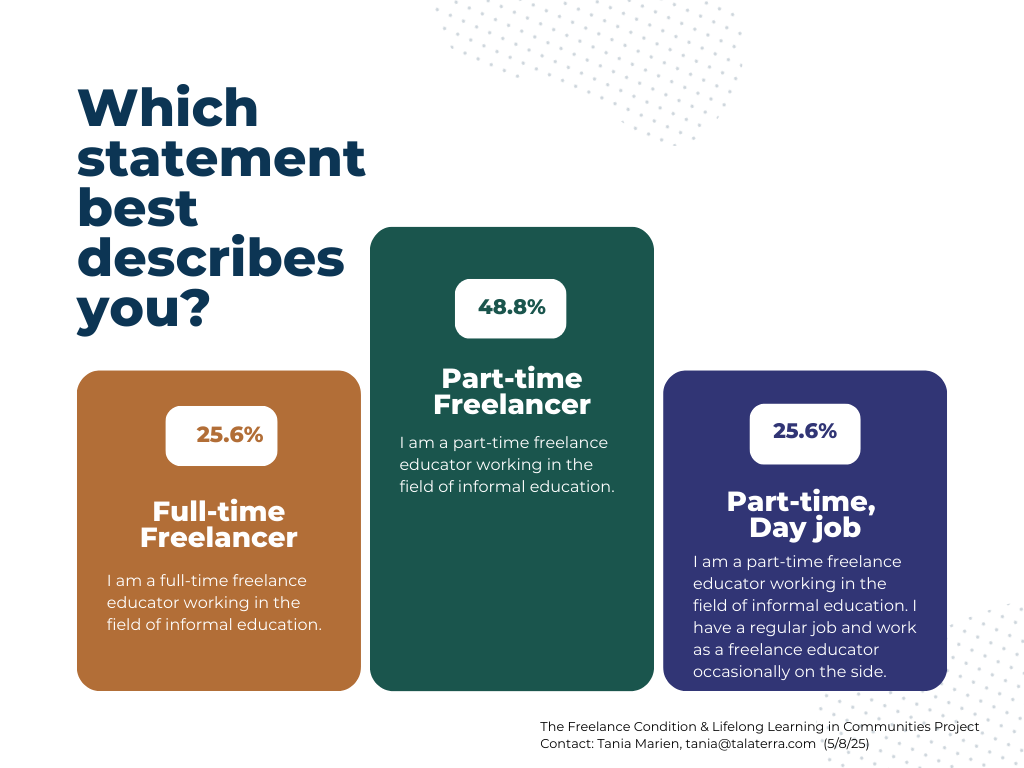

Considering the survey’s overall results, a gap emerged between field experience and compensation.
Was every single person underpricing their services, or was something else behind the compensation gap? Something structural. Systemic?
What else did I learn in the early days of my project?
That I was not alone.
I saw highly motivated, experienced, and educated leaders facing unstable financial situations. Collectively, they are knowledgeable about a range of topics and have years of experience interpreting this knowledge and engaging with the public. Here's a sample of what they shared. It gives a sense of their range.
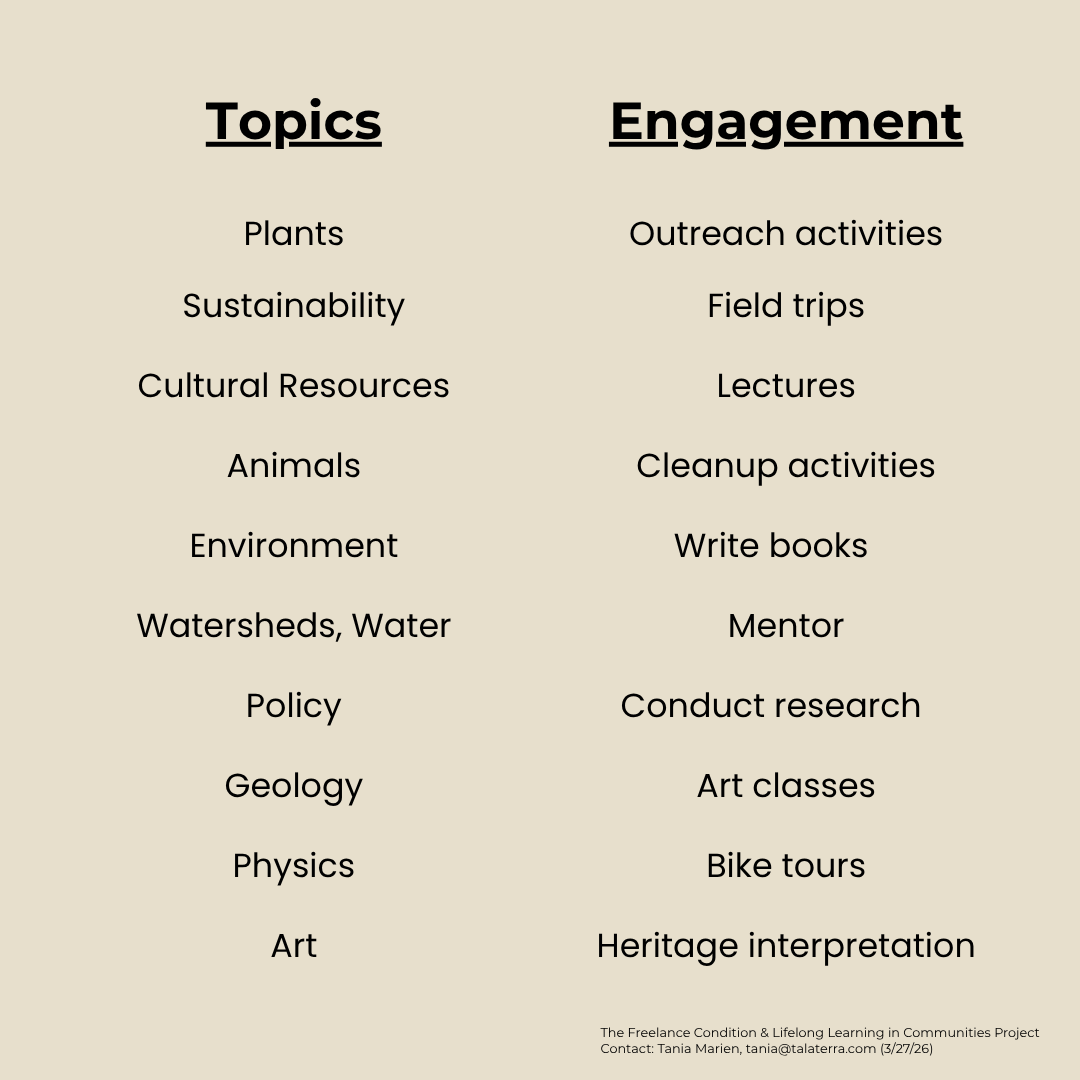
Like me, they were confident their work made a difference.
So I wondered, where is the problem?
I sometimes have moments where I wonder if I’m delusional or dedicated. I can tell you that I would never use the word delusional to describe a colleague. Each one is dedicated to the people they serve and to the changes they want to see. Maybe the problem has nothing to do with an educator’s intention, but rather with the fact that the field doesn’t have language for how independent educators move through it.
More than once, I’ve confused people when I respond to the question, “What site do you work at?” by saying I work independently.
To which I sometimes hear the reply, “I didn’t know you could do that.”
Others have shared similar exchanges. To me, this suggests we don't have language for how freelance environmental education works.
If we don't have language for it, we can't have a conversation about its worth.
________
(1) Rende et al. (2021)

